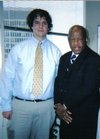
Mark McEntire is an Associate Professor of Religion at Belmont University in Nashville. In his recent column for EthicsDaily.com titled
How Fast Can Rick Warren Spin?, McEntire argues that last Saturday's
Civil Forum on the Presidency held at Saddleback Church and hosted by the
Saddleback Civil Forum (not Saddleback Church) violates the separation of church and state.
McEntire writes:
Let me confess that I believed from the beginning that the so-called "Faith Forum" held on Aug. 16 at the Saddleback Church in California and hosted by its pastor, Rick Warren, was a bad idea.
First, the idea that the two major candidates for president can be summoned to the church of a prominent pastor to kiss his ring and receive his blessing violates both my commitment to the separation of church and state and the kind of communal humility the church ought to demonstrate.
Second, the whole idea of a "faith forum" is a violation of at least the spirit of Article VI of the United States Constitution, which says that "no religious test shall ever be required as a qualification to any office or public trust under the United States." We have now reached a place in American society where it would be simply impossible for a person who is not a practicing Christian to make a serious run for president, or for lesser offices in most places in our country. Not only must a candidate be a practicing Christian, but he or she must be willing to talk about religious faith endlessly.
Other Baptists were skeptical of the Saddleback forum as well. On his blog, Southern Seminary President Al Mohler
wrote:
Suffice it to say that I was not very hopeful about the Saddleback Civil Forum on the Presidency held at the California megachurch last Saturday night. In the first place, I am not really comfortable with the idea of hosting such a politically charged event in a church. No matter how the event is planned and projected, once the event starts it can turn into something far more politically volatile than planned. That is a truth I have learned by hard experience.
Welton Gaddy, another Baptist minister and Executive Director of The Interfaith Alliance, expressed sentiments similar to those of McEntire and Mohler. Gaddy
writes:
I approached Rick Warren's Saddleback Civil Forum with much anticipation, but without a clear idea of how he would handle the sensitive issues at the intersection of religion and politics. I believe Pastor Warren set an example of civility that I hope others will follow, but at the same time some of his questions crossed a line that makes this election seem as if we are electing a pastor-in-chief rather than a commander-in-chief.
Meanwhile, Brent Walker - the Executive Director of the Baptist Joint Committee for Religious Liberty - offers a different perspective over at Newsweek's ON FAITH religion blog. Walker, an ordained Baptist minister and lawyer
writes:
It is good to hear a prominent, evangelical pastor profess his belief in the separation of church and state. I also applaud Rev. Rick Warren's suggestion that separation of church and state does not require a separation of faith and politics. Clearly, there was nothing wrong, as some have suggested, with holding the forum in a church.
Separation of church and state is simply a shorthand expression for the rights guaranteed by Article VI of the Constitution (no religious test for public office) and the First Amendment (no establishment of religion, and no prohibition on the free exercise of religion). What the separation of church and state does not mean is that Americans must - or even should - segregate faith from politics. Nothing in the Constitution or our political culture compels Americans to divorce the moral values born of their religious faith from their decision on which political candidates and policies to support. Answers to questions about a candidate's faith should always be followed up by questions about how that faith will influence governance. Rev. Warren did a pretty good job of doing this throughout the evening.
Southern Baptist layman Charles "Chuck" Colson of the Prison Fellowship ministry seems to concur with Walker. Colson declares that Warren "got Church-State Balance Right."
Here is Colson:
Warren stated it exactly right: There's an institutional separation between church and state. But faith and politics deal with the same questions--how we organize our common lives together. And faith's job is to bring moral truth to the exercise of politics.
The forum was a spectacular success. Most believers gained a much better understanding of where the two candidates stand on issues vital to their faith
I absolutely agree with Brent Walker and Rick Warren. Keeping church and state separate does not mean that we need keep faith and politics separate. In our pluralistic democracy, we must understand that religion and politics will mix, must mix and should mix. But we should remember the wise words of Baptist activists for religious liberty like James Dunn who often declared that "mixing politics and religion is inevitable but merging church an state is inexcusable." We should be aware that there exists "A Proper Mix" between religion and politics. Fortunately, that "proper mix" does not require us to "segregate faith from politics" as Walker notes.
I also tend to agree with Welton Gaddy when he notes that some of Rick Warren's questions "crossed a line." The "what does it mean to trust in Christ" question was probably inappropriate for a Presidential forum. However, as Baptist church-state expert Melissa Rogers has
noted, "Warren's questions were generally much better than the ones journalists asked at previous candidate forums that were sponsored by religious groups....Generally speaking, those journalists focused on abstract theological questions and rather sensationalistic questions about the candidates' personal religious practices or sins. "
I'll conclude with a great snippet from an
op-ed written by Baptist journalist Ruth Ann Dailey of the Pittsburgh Post-Gazette. Her op-ed can serve as a response to McEntire's claims. Here is Dailey:
One distraught caller to C-Span after the Saturday night forum objected to its entirety, citing Article VI of the Constitution: "No religious test shall ever be required as qualification to any office or public trust under the United States."
Her objection is illogical. Rick Warren is not the government, and he invited, rather than forced, the candidates to appear at his church....There's a considerable distance between a religious test for public office and a voter's inspection of a candidate. As the Rev. Warren said weeks before the event, "I believe in the separation of church and state, but I do not believe in the separation of faith and politics, because faith is simply a worldview, and everybody's got a worldview."
Anguished by the bitter church-state battles of my lifetime, I am grateful for Rick Warren's achievement. From the wall of separation's creation more than 350 years ago to its careful tending Saturday night, the Baptist tradition of the inviolability of the individual conscience has served the nation imperfectly, but well.
Labels: Al Mohler, Baptist Joint Committee, Charles Colson, Rick Warren, Separation, Welton Gaddy